About This Template
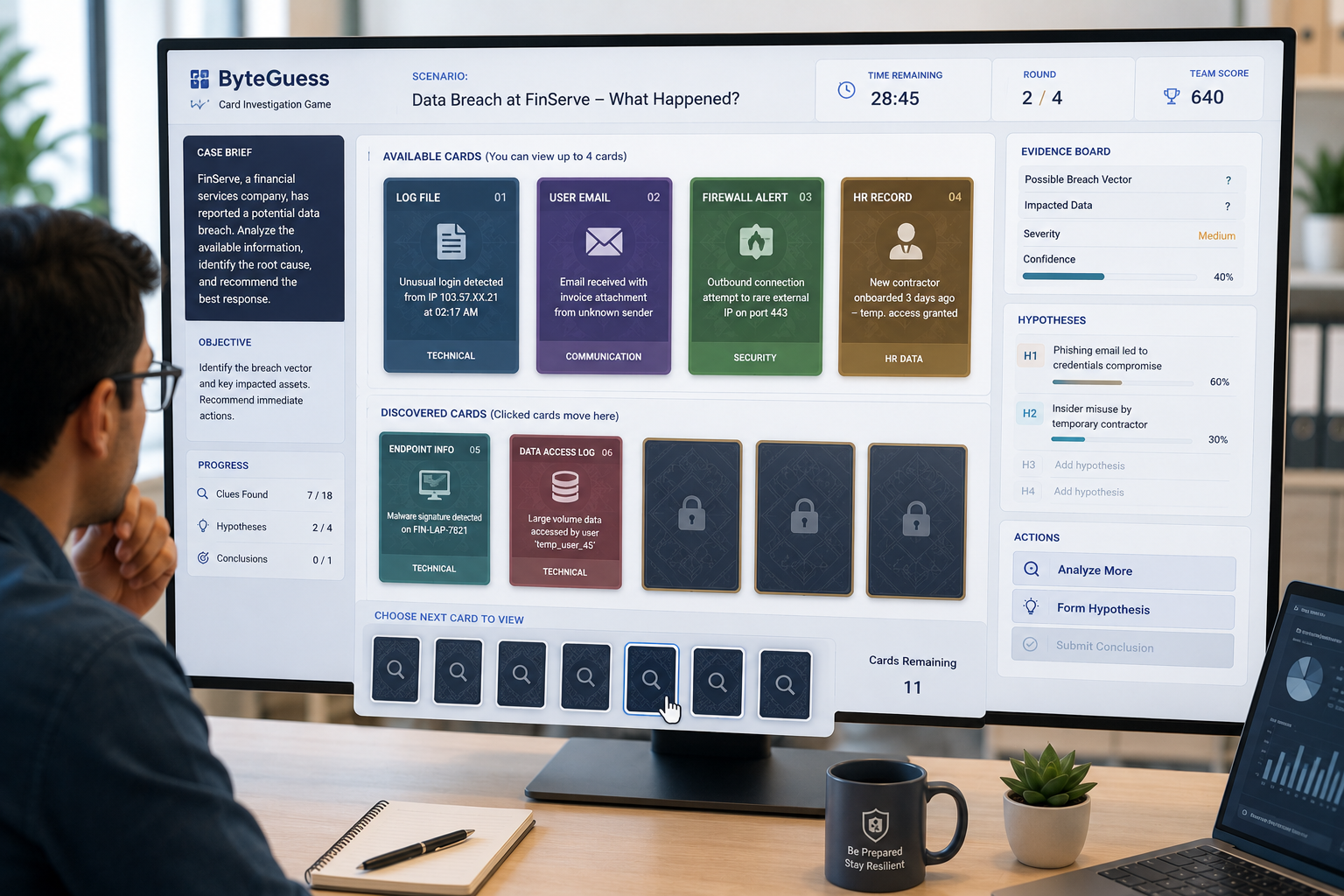
ByteGuess is a card-based analytical game where information is distributed across multiple cards, forcing participants to diagnose challenges using incomplete or fragmented data. Players must collaborate, analyze patterns, and make decisions under uncertainty. The exercise creates a powerful learning environment for analytical thinking, intelligence gathering, root-cause analysis, and collaborative problem-solving. ByteGuess is highly effective in contexts where participants must make informed decisions despite ambiguity or information gaps.
Learning Outcomes
Improve analytical and diagnostic thinking
Strengthen decision-making under uncertainty
Enhance collaborative problem-solving skills
Build awareness of information gaps and assumptions
Develop structured investigation approaches
How It Works
Define Challenge and Card Structure
Choose the learning objective or business challenge participants must solve. Identify the key information categories to distribute across the cards, such as observations, facts, data, statistics, evidence, or witness statements, ensuring each contributes to the overall investigation.
Build Clues and Hypotheses
Create a balanced set of clue cards containing relevant information and optional hints. Define multiple hypothesis options, including the correct conclusion, partially correct possibilities, and carefully designed distractors that encourage critical thinking rather than guessing.
Configure Gameplay and Scoring
Decide how many cards participants can reveal, whether hints are available, and how scores are awarded for selecting the best hypothesis. Configure penalties, bonus points, and hint deductions to suit the learning objective.
Reinforce Learning Through Debrief
Provide detailed feedback explaining why the correct hypothesis fits the available evidence while discussing why alternative options were less appropriate. Summarize the learning points, analytical approach, and common reasoning mistakes.